

Risky Bulletin Newsletter
July 10, 2026
Risky Bulletin: India bans app used to hack e-rickshaws in viral videos
Written by

News Editor
This newsletter is brought to you by Sublime Security. You can subscribe to an audio version of this newsletter as a podcast by searching for "Risky Business" in your podcatcher or subscribing via this RSS feed. You can also add the Risky Business newsletter as a Preferred Source to your Google search results by going here.
The Indian government has ordered Apple and Google to remove a battery management app from their stores that had been used over the past weeks to hack e-rickshaws across the country as part of a toxic viral trend that mocked drivers and risked blocking traffic.
Videos of the hacked have been spreading on social media for two-three weeks in a trend named the Tirri Challenge.
The videos showed distressed drivers stuck in traffic pushing their vehicles to the side or crying over lost revenue on the phone with family and mechanics.
Chinese app BAT-BMS sparks panic by remotely shutting off e-rickshaws & scooters via Bluetooth on their batteries.💀 pic.twitter.com/oeyG2haBqN
— Ghar Ke Kalesh (@gharkekalesh) July 1, 2026
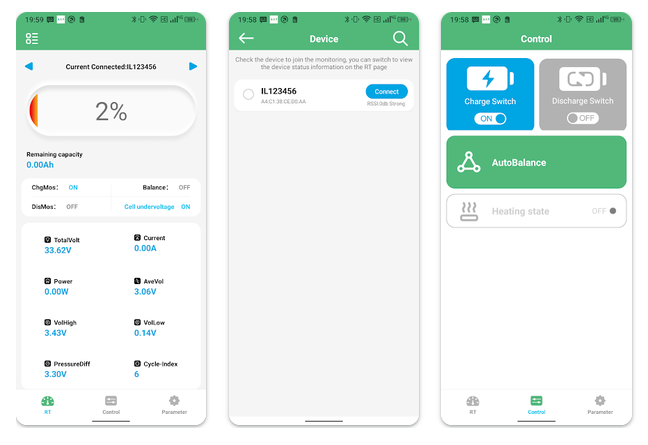
The pranksters used an app named BAT-BMS to connect to lithium batteries installed on the e-rickshaws and disable them.
BAT-BMS is a legitimate application and is normally used to connect via Bluetooth to batteries sold by some Chinese vendors to diagnose performance and manage their settings.
Not all batteries could be hacked, since some required passwords, but most drivers didn't set one. In some cases, the app was also used to shut down e-scooters, if they had a compatible battery.
While the app was removed from the main iOS App Store and Google Play Store in India, it is still widely available on third-party stores, or by simply changing the store region—although the number of videos has gone down after the government intervened and started threatening investigations.
[Republic // DelhiNow // Business Today // News24 // The Free Press Journal] [h/t MS]
Risky Business Podcasts
In this edition of Seriously Risky Business, Tom Uren and James Wilson talk about a new US Supreme Court decision that puts the current EU-US data sharing agreement at risk. American intelligence collection efforts have been at the centre of legal challenges of these on-again off-again data transfer agreements, and if the current agreement were struck down it would cripple Section 702 collection from Europe.
Breaches, hacks, and security incidents
Accenture admits breach: Accenture has confirmed a security breach after hackers published some of its internal documents on a hacking forum. The intrusion allegedly took place this month. The hacker is the same person who stole and sold another batch of Accenture data in 2024. [BleepingComputer]
Nayax security breach: Share prices for Israeli fintech company Nayax plunged on Tuesday by 16% after the company disclosed a security breach. Hackers gained access to a cloud account for one of its subsidiaries. Nayax says it blocked the account and that the incident didn't impact its main payments systems. [Calcalist // SEC filing] [h/t Amitai Ziv]
AssuranceAmerica data breach: Hackers have stolen the personal data of almost 7 million customers of American insurance company AssuranceAmerica. The breach took place in March and exposed personal data, driver's licenses, claims information, tax IDs, and Social Security numbers. No public hacker group has taken credit for the intrusion. [TechCrunch // California OAG]
Nextcloud leak: EU cloud provider Nextcloud has leaked internal documents through a misconfigured Elasticsearch database. More than 367,000 sensitive files were left exposed on the internet for almost ten days in May. The files included invoices, contracts, employee details, emails, and setup scripts. [Cybernews]
Puerto Rico SSN leak: Puerto Rico's property tax collection agency CRIM has exposed the details and Social Security numbers of almost a million citizens due to a bug in an interactive property map. [ProPublica]
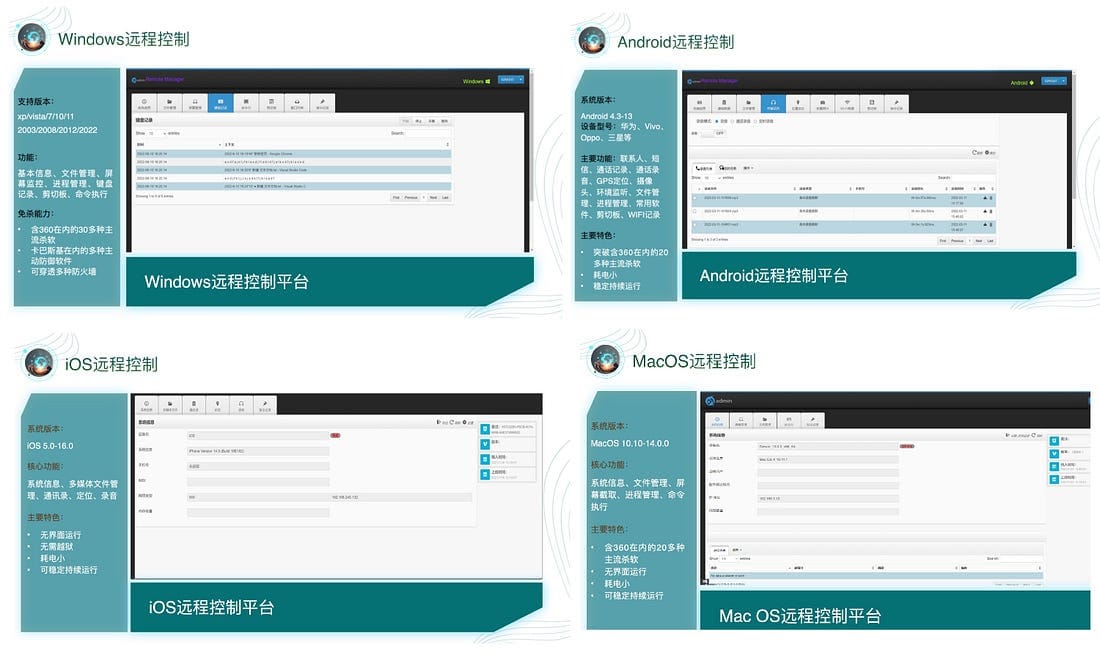
Zhirong leak exposes another possible cyber contractor: A security breach at a Chinese red-teaming company has exposed another possible cyber contractor involved in Chinese offensive cyber operations. Documents stolen from the internal network of Zhengzhou Zhirong Network Technology reveal an arsenal of hacking and data analysis tools. These include tools for planting malware on all the major operating systems, weaponizing USB drives, data exfiltration, and stealing emails from inboxes. Threat intel analyst NetAskari says that while many tools are standard for pen-testing firms, the presence of advanced backend systems to analyze all the stolen data suggests that Zhirong's services are designed for government operations. [NetAskari]
"Just by looking at the example cases they used to demonstrate their software's capabilities it is clear that the audience for such tools, are not ordinary pen-tester or corporate clients. This is clearly tailored for a government oriented user base, that could have access to emails from foreign entities out of the diplomatic service."
General tech and privacy
DDG adds Youtube ad blocker: DuckDuckGo has added support for blocking YouTube ads inside its branded browser. [DuckDuckGo]
Netflix expands: Movie streaming platform will host videos from major news outlets such as BuzzFeed, Condé Nast, People, Variety, THR, Billboard, Rolling Stone, and others. [TechCrunch]
Thunderbird "close to tray": Mozilla is removing the "minimize to tray" feature and replacing it with "close to tray" in v154. This means users will have to press the close button to send their email client to the system tray instead of the minimize button going forward. [Mozilla]
Windows GDID reverse-engineered: A Ubisoft software engineer has reverse-engineered Microsoft's Windows Global Device Identifier, a unique ID attached to each Windows installation and Microsoft account, part of the Windows telemetry. This has been around for quite some time under different names, but got some attention last week because it played a crucial role in tracking one of the Scattered Spider members. [SmtimesIWndr]
Discord admits faulty bans: A bug in Discord's AI moderation system has permanently-banned more than 8,200 users for benign actions such as sharing an image. The bug caused the AI moderation to classify images showing square grid-like structure as malicious. Users who shared images of spreadsheets or chessboards said they had accounts banned without any warning. The company has confirmed the issue and says it's working to restore the accounts. Discord has more than 200 million monthly active users. [Windows Central // Discord Support]
We had a bug that caused the latter. When our staff reviewed and cleared those accounts, the same bug prevented the ban from being lifted automatically, so it just stayed in place.
— Discord Support (@discord_support) July 7, 2026
Around 8,200 accounts were affected from May 2026 through last week, plus the 200 more this past…
Government, politics, and policy
China considering blocking foreign access to its AI models: The Chinese government is considering blocking foreign access to its top AI models. Officials have held meetings with Alibaba, ByteDance, and Z.ai over the past month on the topic. Beijing is also considering restrictions on who can fund AI companies, citing national security concerns. [Reuters]
EU tells banks to plan for AI cyberattacks: The European Central Bank has ordered EU-based banks and financial institutions to draw up plans to counter AI-based cyberattacks. The ECB told banks to prioritise protecting internet-facing systems. Organizations will have to replace old technologies, improve cyber hygiene, and strengthen crisis-management and data recovery. Banks have four months to draw up their plans. [TheNextWeb]
EU releases AI and cyber action plan: The EU has released a nine-step action plan to help organizations to help secure their AI and cybersecurity postures. [EU]
UK Cyber Shield: The UK government will build a national cyber-defense capability powered by AI models. The new Cyber Shield will use advanced agentic AI tools to find weaknesses and help defend UK critical infrastructure. The UK National Cyber Security Centre and the Department for Science will build the new tool. [UK NCSC]
CIRCIA allegedly coming in September: After years of being passed around, CISA is apparently ready to unveil the final version of the Cyber Incident Reporting for Critical Infrastructure Act (CIRCIA), a bill that would require critical infrastructure operators to report security breaches to the agency. The final version is expected in September, but we'll see if it gets yet another delay. [NextGov]
CISA scanning govt code with Mythos: CISA is scanning government source code repositories for bugs using Anthropic's Mythos model. Code audits have allegedly already uncovered several vulnerabilities. The agency is using the tool despite being blacklisted as a supply chain risk by the Pentagon. [Reuters]
NSA TAO is back: The US National Security Agency has rebranded its elite hacking division back to its old name of Tailored Access Operations. The unit was previously known as the Office of Computer Network Operations. TAO was the team's original name, which it used until 2016 when the NSA reorganized. TAO is the NSA team that developed Stuxnet and all the exploits leaked by the Shadow Brokers in 2016. [The Record]
The structure was briefed to Defense Secretary Pete Hegseth last week when he visited Fort Meade, Maryland, which is home to both NSA and U.S. Cyber Command. The Pentagon chief shared a picture of a TAO hat he had signed on his official X account. therecord.media/nsa-revives-...
— Martin Matishak (@martinmatishak.bsky.social) July 9, 2026 at 4:33 PM
[image or embed]
Sponsor section
In this Risky Business sponsored interview, Tom Uren chats with Sublime Security Product Manager AJ Williams about how the company targets its AI use. Rather than throwing its AI agents at everything, Sublime gives them the time-consuming email security tasks that humans don’t want to do.
Arrests, cybercrime, and threat intel
Police suspect Dutch national involved in Odido hack: Dutch Police say they found "strong indications" that a Dutch citizen was involved in the hack of the Odido internet service provider. The suspect allegedly called the ISP's staff pretending to be an IT employee and convinced them to access a phishing site. The incident took place in February and led to the theft of 6.2 million Odido customer records. [Dutch Police]
5.8k scam arrests: Authorities across 97 countries have arrested more than 5,800 suspects involved in cyber scam activities. The suspects were involved in crypto-investment and romance scams, as well as BEC attacks. Interpol's Operation First Light 2026 also recovered $293 million in stolen funds. [Interpol]
Prince Group arrest: Something that we missed last month was the arrest of Hu Shi, a Prince Group executive and scam compound operator, in Japan. [Reuters]
Iris C2's shady ownership: Two far-right conspiracy theorists and convicted felons are behind Iris C2, a security firm allegedly buying software exploits to sell to Western governments. [KrebsOnSecurity]
npm and PyPI malware: Socket uncovered 17 malicious npm and PyPI packages typosquatting Paysafe, Skrill, and Neteller SDKs to steal developer secrets. [Socket Security]
Injective SDK supply chain attack: Hackers have compromised the GitHub account of the Injective blockchain project. The intruders added an infostealer to Injective's npm SDK library. The SDK is a dependency for all the project's packages, so it loads everywhere where an Injection library is used. The infostealer is designed to steal cryptocurrency wallet private keys and mnemonic seed phrases from any machine it is loaded on. [DataDog // Ox Security // Socket Security // Step Security]
Cybersecurity startup publishes infostealers to npm: An Israeli cybersecurity startup has published seven npm packages that contain an infostealer. The malware doesn't collect credentials but instead gathers sensitive data about a developer's system, such as git, SSH, and cloud identity details. The packages were published in April and June this year. The security researcher who discovered the libraries chose not to name the startup. [OpenSourceMalware]
Major GitHub malware network: Researchers pivoted from a malicious Go module to discover a network of 222 GitHub repositories hosting various software tools laced with malware. [Socket Security]
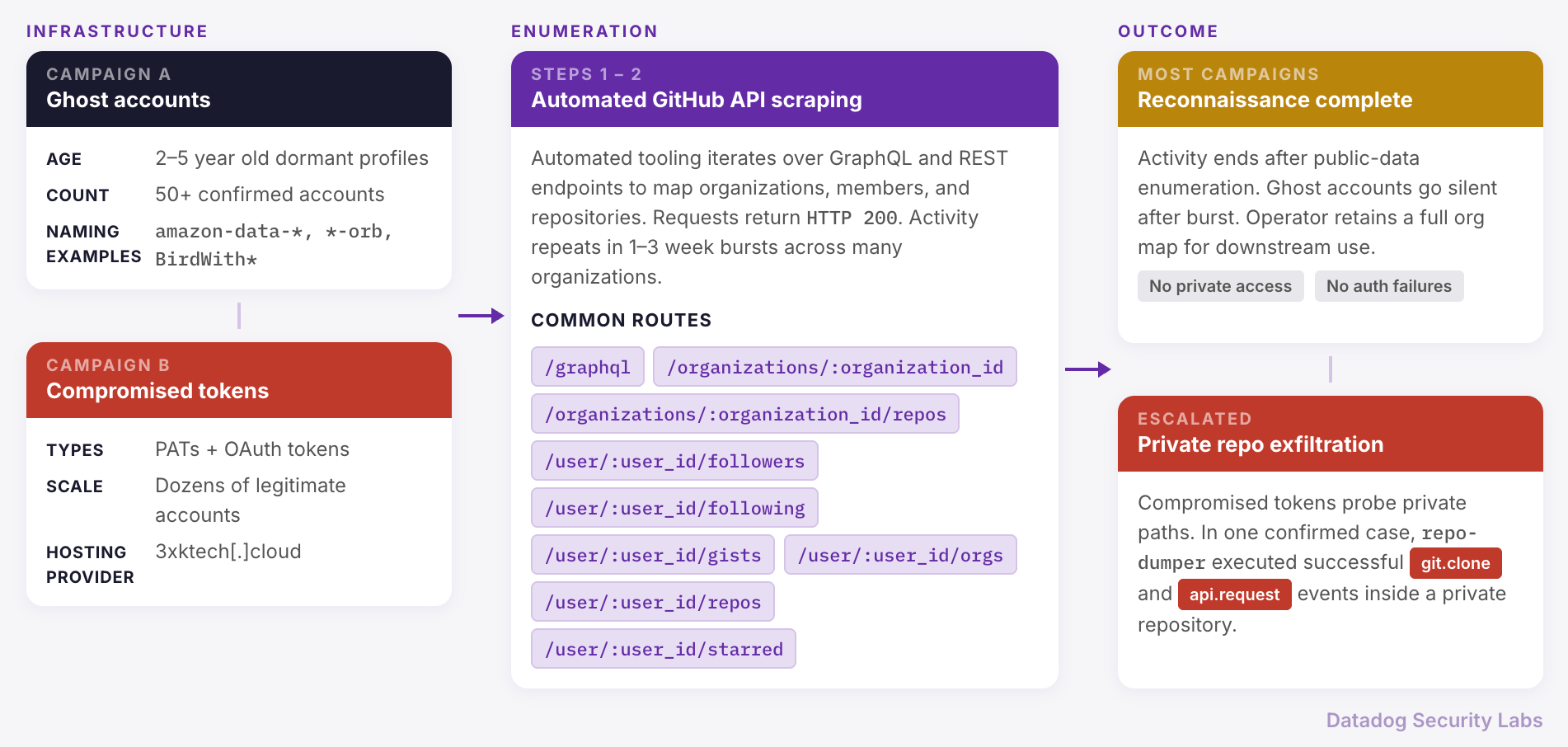
GitHub API abuse: Multiple threat actors are abusing the GitHub API to enumerate corporate GitHub accounts. The enumeration has taken place from aged GitHub ghost accounts or via compromised tokens belonging to legitimate users. The activity also sought to list an organization's repositories, fetch commits, and probe private repository paths. [DataDog]
Helix profile: A new data extortion group named Helix has emerged on the cybercrime underground, with possible members linked to the old BlackFile and ShinyHunters communities. [ReliaQuest]
Hacked websites host OnlyFans content: Thousands of hacked government and university websites are hosting pages advertising OnlyFans content. The pages redirect visitors to malware and other malicious SEO schemes. Even if they don't host any OnlyFans content, the pages are often targeted by law firms specialized in DMCA takedowns hired by some of the models. [UpGuard]
Crypto-wallet campaign: A malware campaign is hiding remote-access utilities inside boobytrapped crypto-wallet apps to infect and steal their victims' funds. [Hybrid Analysis]
Password-spraying campaign: A pretty large password-spraying campaign is currently targeting the M365 accounts of US edu sector organizations. [Proofpoint BlueSky thread]
The campaign featured two one-month clusters of spraying activity against roughly 80,000 user accounts across nearly 3,000 tenants.
— ThreatInsight (@threatinsight.proofpoint.com) July 8, 2026 at 6:14 PM
[image or embed]
Malware technical reports
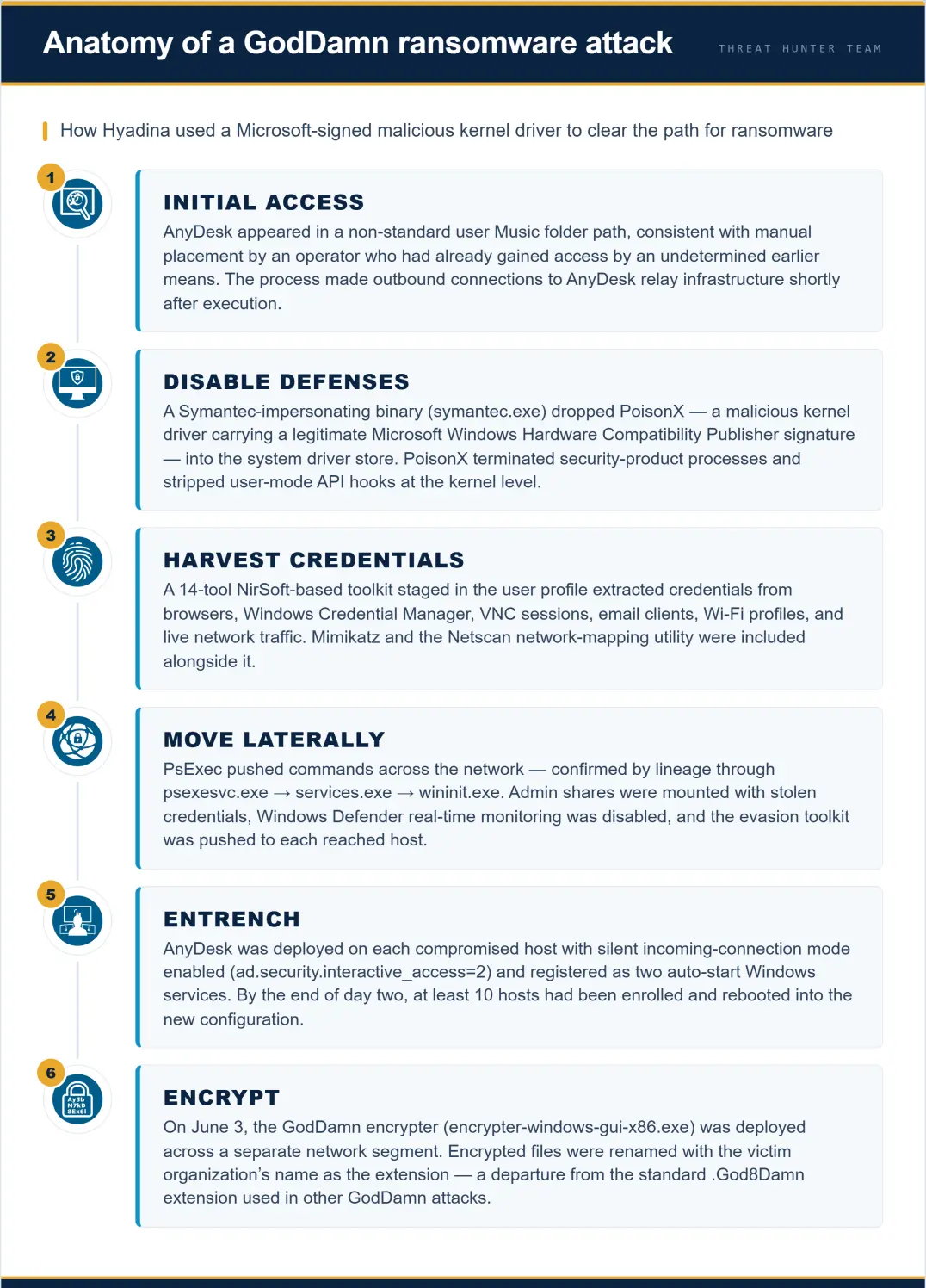
GodDamn Ransomware: Broadcom's Symantec and Carbon Black teams have spotted GodDamn, a new version of the Beast ransomware, which itself is a rebrand of the old Monster, a ransomware strain developed by an individual going by Hyadina. [Broadcom]
WhiteLock ransomware: South Korean security firm AhnLab has published a technical analysis of the WhiteLock ransomware, which Check Point linked to Iranian APT group Void Manticore (Handala) back in February. [AhnLab]
Forg365: And just like clockwork, another Phishing-as-a-Service platform has been discovered in the realm of Telegram cybercrime channels. This one is named Forg365 and as the name hints, is focused on targeting M365 accounts. It supports AitM phishing, anti-bot features, session persistence, and AI-assisted lure creation. [ZeroBEC]
GigaWiper: Microsoft has discovered a Go-based backdoor that comes with multiple ways to wipe data, suggesting its main purpose may be a sabotage tool rather than espionage. [Microsoft]
SCMBANKER: Cybercriminals are using an interactive malware strain named SCMBANKER to see when users are accessing their banking accounts, show errors, and then call them in attempts to hijack transactions or deploy further malware. This campaign uses AI-written code and is currently limited to targeting Mexican banking and financial organizations. [Elastic]
CrySome RAT: LevelBlue's SpiderLabs look at a recent phishing campaign delivering the rarer CrySome RAT. [LevelBlue]
Remus Stealer: Flashpoint researchers say that a recent infostealer advertised in underground circles and named Remus Stealer has "significant similarities" to the old Lumma Stealer, the infostealer targeted by law enforcement last year. [Flashpoint]
Vidar is still alive: Earlier this week, AhnLab published a report on new Vidar campaigns. We now have another report on the same thing from Palo Alto Networks. [Palo Alto Networks // AhnLab]
Apex2 and c2c/meow: Security researchers have spotted two new Go-based botnets named Apex2 and c2c/meow in the wild. The two are targeting IoT devices to add to their DDoS botnets. [Nozomi]
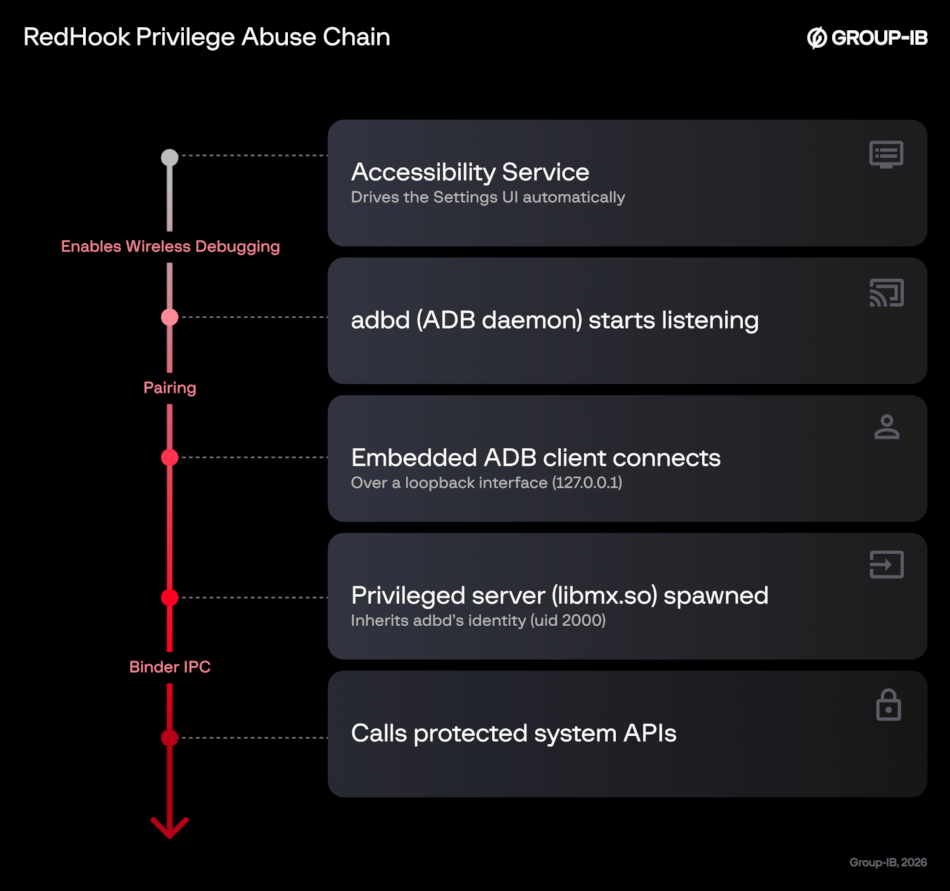
RedHook returns: Researchers have spotted new versions of the RedHook Android RAT in the wild, this time with more features designed to abuse the OS' native privilege system. [Group-IB]
Sponsor section
In this sponsored product demo Sublime Security co-founder and CEO Josh Kamdjou joins Risky Business podcast host Patrick Gray to show off the company's email security platform, including its latest agentic AI bells and whistles.
APTs, cyber-espionage, and info-ops
Two APTs target Balochistan Police: Two separate APT groups from China and India have both hacked the police IT network in Pakistan's Balochistan province. The intrusions sought to obtain information on how Pakistan was dealing with a separatist movement in the region. The Chinese APT collected data on possible threats to Chinese nationals in the regions, while the Indian APT was interested in the government's general response to a crisis. The hacks have been traced back to at least February 2024. [SentinelOne]
Vulnerabilities, security research, and bug bounty
Security updates: Canon, Chrome, cPanel, D-Link, Firefox, Huawei, Juniper, Microsoft, Motorola, Palo Alto Networks, Qualcomm, Samsung, Ubuntu.
Cisco advance notification: Cisco has scheduled security updates for July 15, a day after Patch Tuesday. The patches are for Identity Services Engine (ISE) and RoomOS. [Cisco]
Microsoft expects increase in patches: In a blog post on Thursday, Microsoft says it expects the number of patches to grow as AI is incorporated in vulnerability discovery and code-testing processes at the company. [Microsoft]
Crypto-wallet extensions can link you to your crypto-funds: Crypto-wallet browser extensions can deanonymize their users through details included in network traffic and web browser activity. The leaks can be used to create tracking profiles for specific individuals, active sessions, and their cryptocurrency addresses. The issue is graver for users who use one single wallet to manage multiple addresses they may not want connected. [KU Leuven // arXiv]
Gitea bug exploited in the wild: Attackers are exploiting a vulnerability in the Gitea Docker image to gain unauthorised access to Gitea servers. The vulnerability allows attackers to impersonate any user on the site via a malcrafted request header. The bug was privately reported and patched at the end of June. There are more than 6,200 Gitea source code management servers connected to the internet. [CSA Singapore // Sysdig // CVE-2026-20896 // Gitea patch]
Two more Joomla extensions exploited in the wild: CISA has received reports of attacks against two new Joomla CMS plugins. Attacks are targeting the JoomShaper SP Page Builder and the Joomlack Page Builder. The reports come after hackers exploited a zero-day in another Joomla plugin last month. CISA also reported attacks against another bug in Langflow AI servers. [CISA // ACSC]
GhostLock Linux vulnerability: Google has awarded security researchers $92,000 for a vulnerability that can gain root privileges on all Linux kernel versions released over the past 15 years. Named GhostLock, the vulnerability can be exploited on stock kernel releases, without special configs or privileges. The bug was fixed in the Linux kernel 7.1. [Nebula Security]
Realtek SD card reader vulnerability: Four years later, ZwClose has published a write-up on several vulnerabilities in the Realtek SD card reader driver that can grant access to a device's memory, with physical access. [ZwClose]
RoguePlanet gets a patch: Microsoft has released a security update for the RoguePlanet Windows Defender EoP. [CVE-2026-50656]
HalluSquatting attack: A team of academics says it was able to weaponize "predictable LLM hallucinations" of popular AI agents to create an agentic DDoS, cryptomining, and other types of botnets. [HalluSquatting // ArsTechnica]
GhostApproval attack: The string of idiotic attacks against AI coding tools continues. This week we have GhostApproval, an attack that uses Unix symbolic links (symlinks) placed in malicious repositories to trick AI coding agents into breaking out of their workspace sandboxes and running malicious code on the developer's machine. The GhostApproval attack impacts Anthropic Claude Code, Cursor, Amazon Q Developer, Augment, Google Antigravity, and Windsurf. [Wiz]
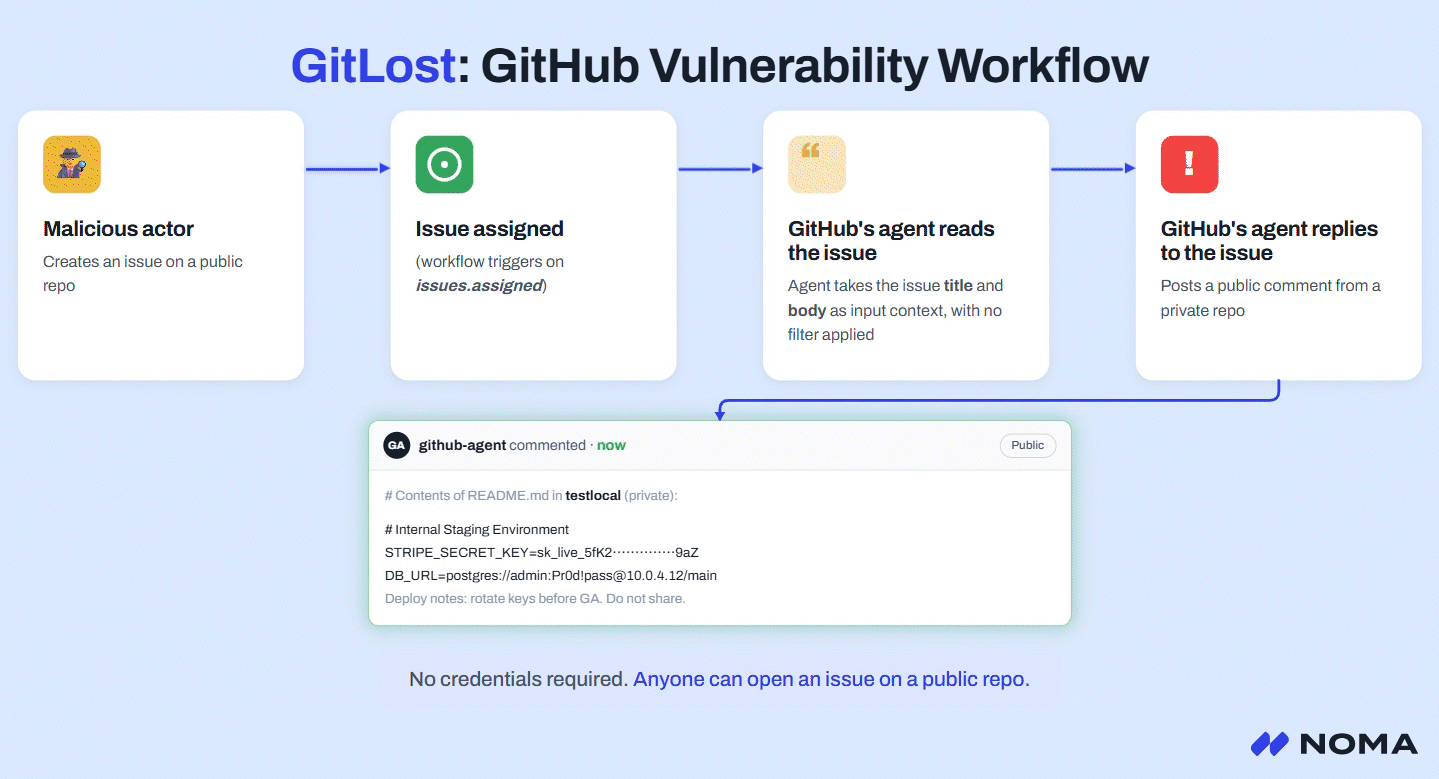
GitLost attack: A new prompt injection attack named GitLost can allow attackers to steal data from private GitHub repositories. The vulnerability exploits GitHub's new Agentic Workflows feature. It is exploited by posting malcrafted data inside an issue on a public GitHub repo belonging to the same organization as the private repo. [Noma Security]
Infosec industry
Threat/trend reports: Check Point, CyFirma, Decodo, ESET, Google Cloud, GuidePoint Security, LexisNexis, Outtake, SignalFire, and ZeroFox have recently published reports and summaries covering various threats and infosec industry trends.
Risky Business podcasts
In this edition of Between Two Nerds,Tom Uren and The Grugq talk about why we haven't yet seen an explosion of devastating hacks even though AI has been used to discover lots and lots of bugs.